|
Express Lease |
Dealer Programs | |||
American Bank Leasing provides leasing and financing for transactions up to $100,000 based on a one page application. Credit decsions are based primarily on three factors:
1. Customer's willingness to pay obligations as demonstrated on principals' credit bureau reports (FICO Scores from Equifax)
2. Commercial Bank Reference demonstrating adequate average bank balance
3. Company's time in business. Over 2-3 years demonstrating staying power.
If you have paid your bills on time and your company is profitable the chances are excellent that your credit will be approved.
What FICO scores look at:
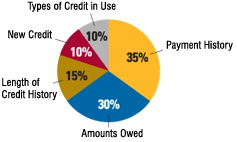
These percentages are based on the importance of the five categories for the general population. For particular groups-for example, people who have not been using credit long-the importance of some categories may be different.
What FICO scores ignore:
FICO scores do not consider:
— Your race, color, religion, national origin, sex and marital status
— Your age
— Your salary, occupation, title, employer, date employed or employment history
— Where you live
— Any interest rate being charged on a particular credit card or other account
— Any items reported as child/family support obligations or rental agreements
— Certain types of inquiries (requests for your credit report)
— Any information not found in your credit report
— Any information that is not proven to be predictive of future credit
Answers to Your Questions About FICO® Scores 
What is a credit score?
A credit score is a number lenders use to help them decide: "If I give this person a loan or credit card, how likely is it that I will get paid back on time?" A score is a snapshot of your credit risk picture at a particular point in time. There are many types of credit scores, but the most commonly used are credit bureau scores. Credit bureau scores are based solely on information in consumer credit reports maintained at one of the credit reporting agencies. Other types of scores may also include information from credit applications or bank files. The most widely used credit bureau scores are developed by Fair, Isaac and Company. These are known as FICO scores. Complete information on credit scoring can be found online at www.myFICO.com.
How does credit scoring help me?
Credit scores give lenders a fast, objective measurement of your credit risk. Before the use of scoring, the credit granting process could be slow, inconsistent and unfairly biased. Credit scores have made big improvements in the credit process. Because of credit scores:
— People can get loans faster
— More credit is available
— Credit decisions are fairer
— Credit rates are lower overall
What is a good FICO score to get?
Since there's no one "score cutoff" used by all lenders, it's hard to say what a good score is outside the context of a particular lending decision. For example, a FICO score of 750 may qualify you for a platinum credit card, whereas a score of 675 may indicate you're a better match for a standard card.
How can I find out my FICO score?
You can now purchase your own FICO score at two different sites on the Internet. Go to www.myFICO.com or www.equifax.com to access Score PowerTM, a service brought to you by Fair, Isaac and Equifax. You'll receive your current FICO score, your Equifax credit report, a full explanation of your score, and advice for improving your score over time.
Some lenders also may tell you your score, if they are using it to make a lending decision. In California, state law requires lenders to tell you your score if they use it in connection with your mortgage application. In all 50 states, if you are turned down for credit based primarily on your score, the lender does need to give you the reasons why your score wasn't high enough to qualify. This can help you understand your credit picture and how to improve it.
Note that FICO scores are also called BEACON® (at Equifax), the Experian/Fair, Isaac Risk Model (at Experian) and EMPIRICA® (at TransUnion). Any other score is not your FICO score.
Who can use the FICO® Score Simulator and how often can they use it?
Anyone who purchase a Score Power report after 5/9/02 may have unlimited access the FICO Score Simulator on their most recently purchase Score Power report for up to 30 days after the Score Power purchase date.
What if I'm turned down for credit?
If you have been turned down for credit, the Equal Credit Opportunity Act (ECOA) gives you the right to obtain the reasons why within 30 days. You are also entitled to a free copy of your credit bureau report within 60 days, which you can request from the credit reporting agencies.
If the score was a primary part of the lender's decision, the lender will use the score reason codes to explain why you didn't qualify for the credit. (They often may not tell you your score because the reasons behind it are more useful-but you can ask.)
If your credit application was turned down, or you didn't qualify for the interest rate you wanted, ask your lender how you can improve your credit picture.
Tips for Raising Your FICO® Score
Scores reflect credit payment patterns over time with more emphasis placed on recent information.
To improve your credit score:
— Pay your bills on time.
— Keep balances low on credit cards and other "revolving credit."
— Apply for and open new credit accounts only as needed.
— Don't close unused credit cards as a short-term strategy to raise your score.
— Check your own credit reports for accuracy.